
Part 1: So Long, and Thanks for No Biosolids

After an 18-month private development project fell apart in March, a trove of public records related to the attempted deal show a deeply-embedded tension in East Hampton that revolves around residents, private developers, and public officials who at times have found their interests misaligned or even at complete odds.
The project involved a facility that was intended to process sludge into a product called biosolids, a term developed by the wastewater industry in the 1990s to differentiate raw sewage from the treated end-product. The biosolids processing facility was first pitched by former public utilities administrator Anthony DeSimone to Griffin Residuals, a Georgia-based LLC, a few weeks after DeSimone started his position in the summer of 2024. The project ended abruptly in March this year after dozens of residents expressed concern on social media and during public meetings.
Michael Piergallini lives about five minutes from the proposed site.
“I think it was very clear that there was a lot going on behind the scenes that you may or may not have been aware of,” Piergallini said at the March 12 Town Council meeting during public comment.
Tid Griffin, owner of Griffin Residuals, confirmed with The Bellringer that his company is no longer working with the town to build a biosolids treatment facility.
“We are not talking to anyone at this point about continuing anything in East Hampton,” Griffin said. He declined to comment on whether his company was looking elsewhere in Connecticut or New England, although his website still lists Connecticut as a location for future development.
Oh Property, Where Art Thou?
Griffin Residuals placed an offer for a property near the town’s Wastewater Treatment Plant in February, according to emails obtained by The Bellringer through a Freedom of Information Act request. However, a social media campaign against the purchase led to Griffin’s decision to not purchase the property and discontinue searching for other parcels, multiple sources have confirmed. Resident concerns focused on the lack of public input in the project and the signing of a Letter of Intent with Griffin in late 2024 that was never publicized or even communicated to the Town Council.
David Cox, town manager, acknowledged that the location, and the process, were flawed.
“The hurdle was pretty high,” Cox said in an interview. “To get approval for that kind of facility, in East Hampton, and in that particular location… there’s households there, and it’s already challenging to have a wastewater treatment plant with households that close.”
However, as the project grew in scope, other potential developments were discussed, emails showed, including partnering with Saint Clements Castle to bring a 100-room hotel to town, and possibly bringing a water-bottling company here. Land swaps were discussed, and public funds were offered to aid Griffin’s project. These discussions happened, for the most part, without Town Council’s knowledge and were led by DeSimone, who was terminated in March amid public outcry about his development pursuits.
Below are screenshots from the above referenced emails.
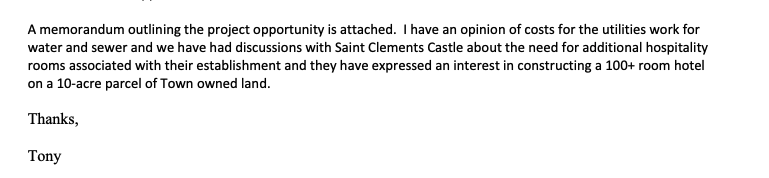
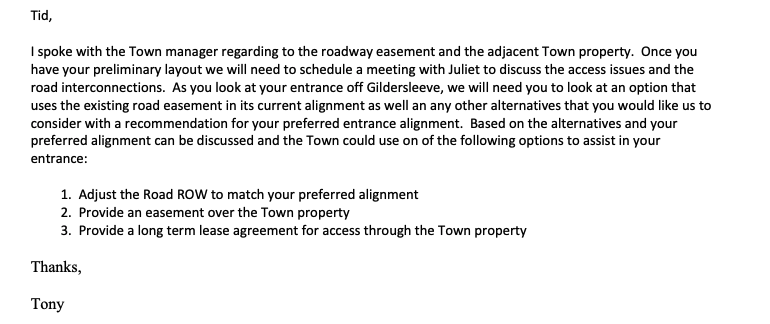
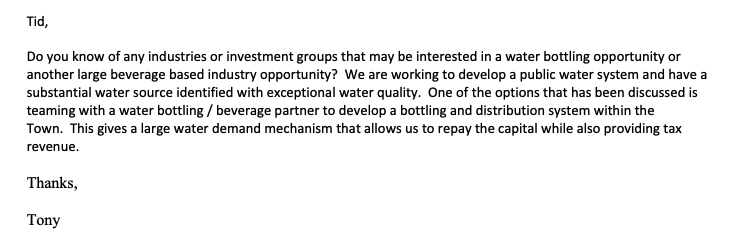
DeSimone declined to comment for this story, citing legal concerns.
“I am not able to provide comments or respond until such time as my situation advances through the legal process,” he stated in an email.
Emails show that Griffin had explored other properties in town, but settled on a location near the Gildersleeve facility. That location, a property off Coughlin Road owned by Frank McLean, was one of several in that area Griffin had explored. In a February 2026 email to former members of the Water Pollution Control Authority, DeSimone wrote that Griffin was expecting to close on a property within 90 days, but didn’t give a specific address.
“Griffin and the property owner on the site adjacent to the WPCF have reached a deal for the sale of the property,” DeSimone wrote. He later followed up, telling his colleagues that a non-disclosure agreement (NDA) had been signed by the real estate parties and to “[p]lease keep it quiet.”
These NDAs make it difficult to determine which properties Griffin actually offered to purchase. Griffin declined to comment on which properties he sought. Buddy McLean, Frank’s son and owner of McLean Hill Farm, also declined to comment.
However, DeSimone appeared to take an active role in the property search, sending Griffin various town maps and information on property owners. He also provided updates to some of his colleagues in the town’s administrative offices, though Town Council members generally seem to have been left out of these communications.
In a December 2025 email, DeSimone reached out to Cox and Juliet Hodge, the town’s planning and zoning administrator, informing them of the status of the Coughlin Road deal.
“The McLean’s countered at $500,000 for the Coughlin Road property,” DeSimone wrote. “This is an unrealistic price…”
He then suggested the town could sell a property “behind the fuel depot, 5 Gildersleeve Drive,” and noted the need to address the wetlands at that location prior to development.
DeSimone also emailed Griffin information about the layout of 292 West High Street, asking him for a concept design to help manage the wetlands. DeSimone also referenced three addresses: “5 Gildersleeve Drive, 288 West High Street and some of the 1A parcels,” with 1A being between 5 Gildersleeve and the wastewater plant property. There is currently a residential building at 288. A message to the property owner has not been returned.
In the Letter of Intent, signed by the town and Griffin in November of 2024, the biosolids plant was “to be located at, or adjacent to, 20 Gildersleeve Drive…” and that the “business relationship is anticipated to include Griffin Residuals’ purchase or lease” of publicly-owned property or “acquisition of adjacent, privately owned land at the proposed site.”
It’s unclear why the Letter of Intent included this specific location as the designated site, especially given historical concerns raised by residents who live near the current treatment plant, and the history of sewage expansion projects in town, which some have called short-sighted. Cox suggested the location might have been chosen because Griffin was planning to use “gray water,” or effluent from the nearby wastewater treatment plant, as part of its biosolids processing, which would allow the facility to avoid using well water or public water.
In an interview, Dean Markham, Town Council chairman, discussed several problems with the plan that emerged as public concern mounted.
“It’s just a horrendous location,” Markham said. “There are all kinds of issues with trucks…. The size of the plan seemed to change… and the original concept indicated, or was portrayed as not having a lot of odors and things of that sort – nuisances. And they just didn’t seem to pan out.”
Backroom deal?
The Letter of Intent was a significant development in the advancement of this project, yet the Town Council was never informed that this letter existed. The council was first apprised of the project in June of 2025, roughly eight months after the Letter of Intent was signed.
“If I failed to send that to them, that’s on me,” Cox said. “That’s something I would normally have done… It wasn’t intended to be, you know, a secretive thing.”
During the June 2025 council meeting, several board members expressed approval of the biosolids plan. Councilmember Richard Knotek implored DeSimone on two occasions to “sell it,” by focusing on tangible benefits the facility would have for the town, such as the possibility of generating up to $1.6 million in annual tax revenue.
The Bellringer emailed Town Council members through its general email address, which is posted on the town website. Councilman Jack Solomon was the only member to respond. In an interview, Solomon said he thought the project was a good idea, especially after Griffin had answered many of his questions. But he wasn’t aware at how far along the project had gone without Town Council’s awareness.
“There never was really any possibility, because there was never a location that made any sense,” Solomon said.
However, the Letter of Intent included a specific location – near the wastewater treatment plant – but, again, the Town Council wasn’t aware the letter had been signed.
The undeveloped property at 292 West High Street, owned at the time by Reinhard Vonhollander of West Hartford, was also a potential site for the biosolids processing. However, Vonhollander confirmed that Griffin never made an offer for that parcel.
Records show that Vonhollander purchased the vacant lot under the VH LLC for $65,000 in September of 2025. Roughly five months later, DeSimone emailed him with information the town’s process for purchasing land, and referenced 292. Emails show that there might have been an affordable housing plan for that location using the 8-30g statute, a state law that allows developers to sidestep local zoning authority a town doesn’t have a minimum percentage of affordable housing.
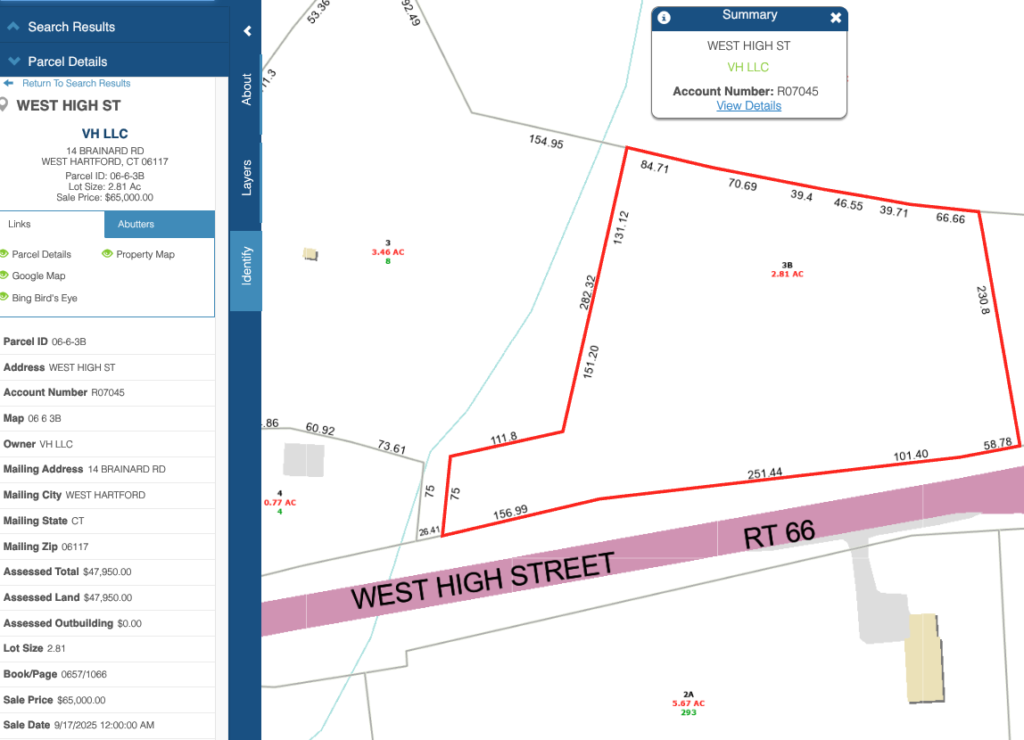
East Hampton eventually bought 292 in April, a month after Griffin dropped its plans and pulled out of its real estate deal (or deals), choosing to set the land aside as open space. The town had initially expressed interest in purchasing the property through its partnership agency with Colchester, known as the Joint Facilities, for future upgrades to the treatment plant. However, that plan was scrapped after public outcry expressed concern about expansion of the plant, even though the plant’s capacity wasn’t slated to increase, only its footprint.
At a Planning & Zoning Commission meeting prior to the purchase, DeSimone noted that the town could take 292 via eminent domain for the wastewater project, but it could not do so for conservation purposes. Eminent domain is a controversial Fifth Amendment right governments can evoke to take private property for public purposes, as long as the government pays the owner “fair market value.” The property is currently off the market, but is listed at $55,000 on Zillow as of this writing. By selling to the town at $105,000, Vonhollander’s seven-month property investment grossed a $40,000 profit.
After residents rallied against the plan to buy 292 West High Street for sewage treatment upgrades, the town shifted gears. Led by Councilmember Ted Hintz, who lives near the site, the property would instead be used as “open space and buffer lands.” In April, the town bought the parcel following a town meeting in which 88% of voters approved the purchase.
A complicated future
Town Manager Cox pointed out that late last year, state lawmakers passed a new housing law that requires, among other things, smaller municipalities like East Hampton to develop a “housing growth plan” by 2028 that assesses infrastructure, identifies housing growth opportunities, and inventories developable land.
“Basically, the legislature took a position, that we don’t have enough housing in Connecticut, and they’re going to force municipalities to allow housing to be built,” Cox said.
For now, 292 West High Street remains a town-owned property, but many residents remain skeptical about private development projects that aren’t in the town’s best interests. For his part, council chairman Markham, who works as a real estate agent and is currently representing the Downey family’s sale of a portion of Hazen Tree Farm, development can be tricky in a small town.
“I think Tony had good things in mind for the town,” he said. “One of the strong points he had was his sort of creative thinking – outside-the-box – what he could do to improve the finances of the town.”
The pursuit of private development was not part of the public utilities administrator’s job duties, according to the job posting Cox sent The Bellringer. However, that is part of Cox’s role, Markham said.
“The town manager has always been a position [that aims] to improve the tax base of the town,” Markham said.
Improving the tax base is only one side of the development coin. On the other is land preservation, and maintaining the town’s rural character, something that many town residents have expressed should be a priority.
Next in the series: Exploring the process of preserving land by looking at the sale of land near Hazen Tree Farm. Later, we’ll explore public/private development partnerships and when they work and when they don’t. And finally, we’ll examine biosolids in-depth because, let’s face it – poop is a problem.