
Tree Farm to Remain, But Residents Fear Overdevelopment
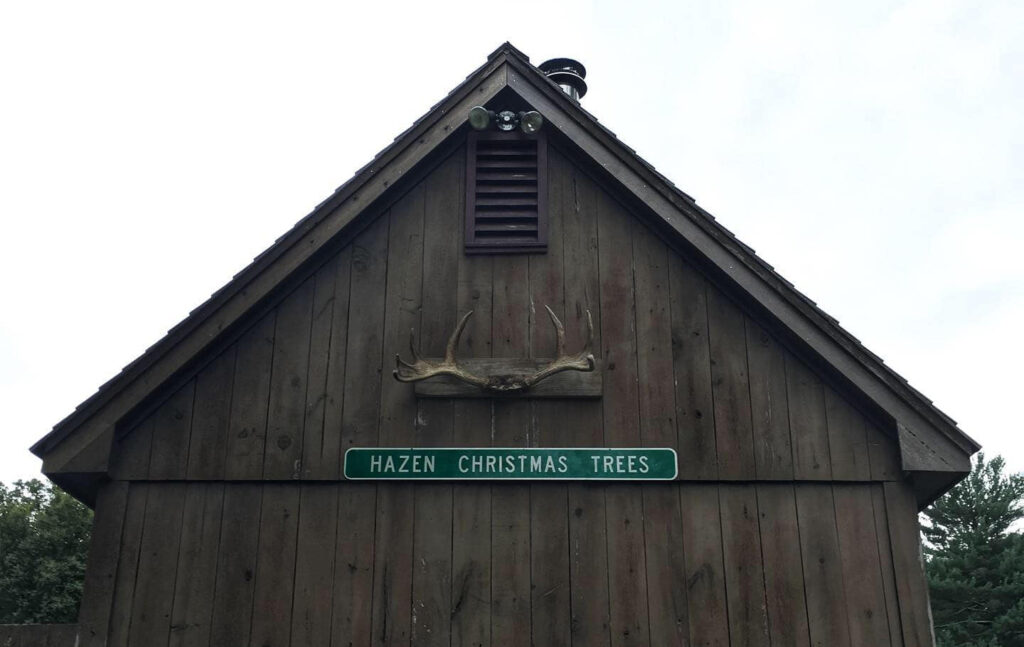
When word popped up on Let’s Talk East Hampton Facebook page that the Hazen Tree Farm could be for sale, it landed the way those things often do in a small town. Over a hundred comments rolled in with a general consensus: Many residents do not want this land developed.
No listing has appeared in public records or through property listings at the time of this publication, but The Bellringer has confirmed through two sources that approximately 76 acres of land owned by three members of the Hazen Tree Farm family is on the market. While the owners are holding onto a couple of acres to keep the farm open, much of the remaining property is for sale, according to Peter Downey, whose mother, Kathy, is among the owners.
Dean Markham, the town council chairman who is also the seller’s real estate agent, confirmed that four parcels are for sale for roughly $1.2 million. The land has not been listed on any commercial property sites, Markham said, to allow the sellers to target “qualified buyers.”
“We are not just running to anyone,” Markham said. “We’re looking at potentially qualified, sympathetic developers who would do a good job if they desire to move ahead with such a purchase.”
Kathy Downey, one of the three owners, bought her family’s Christmas tree farm in 2018. During a public hearing about proposed farm legislation at the state capitol in 2024, she submitted written testimony stating that she wanted the property “for three reasons: a place to retire, to keep my Dad’s name on Hazen Tree Farm, and lastly for this land not to be developed.”
The Bellringer attempted to connect with Kathy Downey through Markham and through her son, but both said she would likely not comment.
As a private property, the owners reserve the right to sell to whomever they choose. In an email to The Bellringer, Peter noted that the town lacks an open-space plan that would work to preserve properties that go up for sale. East Hampton, he said, has too often relied on “private landowners for that open space feel.”
“If this town does not want development,” he wrote, “it better find out how to preserve large tracts of land before it’s too late.”
A portion of the properties are in the Lake Pocotopaug watershed. Many residents have expressed concern that development near the lake needs to be minimized to lessen potential negative impacts on the lake, which has suffered from occasional algae blooms despite a multi-million dollar mitigation effort that’s been ongoing for years.
Markham pointed out that whatever development came to the area would have to comply with zoning regulations. He also noted that he was not marketing the property to land trusts or other possible buyers whose interest in the land would be solely for preservation.
For people concerned about preserving open space, Connecticut has an established set of tools through various collective purchasing processes that ensure landowners get a fair price for their properties while simultaneously ensuring the land remains undeveloped and open to the public. The question is whether the community moves before developers.
WHAT’S AT STAKE
The Hazen farm sits on Lake Drive, a short distance from Lake Pocotopaug, in a part of town that has already absorbed considerable residential pressure. Analysis of U.S. Census Bureau data shows that the town’s population has remained relatively flat since 2010, but housing has continued to increase. However, the percentage of these homes classified as affordable remains well below the required 10-percent threshold established by the state (see section on 8-30g below).
Under current East Hampton zoning, a large parcel of land near the lake carries significant development potential. A buyer with subdivision ambitions would not be operating outside the rules; though they would still need approval by the various town bodies before construction could begin. The developer could invoke 8-30g to build affordable housing, and the town’s ability to prevent such a project would be limited to its impact on health or safety.
The Conservation-Lake Commission is separately authorized under the town code to recommend land and easement acquisitions to the Town Council for open space and recreation purposes. Once a developer owns the deed, the Conservation-Lake Commission and the Town Council have no authority to block development. The Planning and Zoning Commission (PZC) retains review power and could deny or significantly constrain a project that requires a zone change, variance, or special permit. The Inland Wetlands and Watercourses Agency (IWWA) has independent authority as well: if any work is proposed in or adjacent to a wetland or watercourse, the developer must obtain a separate permit, which the agency can deny or condition on its own grounds. However, a developer can appeal both a PZC denial and an IWWA denial to Connecticut Superior Court, which can limit how far either body can go in stopping a project the developer is determined to build.
This is not a hypothetical problem unique to East Hampton. Across Connecticut, preservation is running decades behind the state’s own open space goal, with the state estimating it would take approximately 57 more years at the current pace to protect its own share of Connecticut’s land. This is further complicated by state mandates that require towns to have enough affordable housing, and recent legislation that requires towns to create a development plan. Aaron Lefland, deputy director of the Connecticut Land Trust Conservation Council (CLCC), said that the communities that kept their open spaces tended to have a plan ready or a land trust already at the table.
HOW LAND CONSERVATION WORKS IN CONNECTICUT AND HOW A FAMILY GETS PAID FAIRLY
Connecticut has around 120 land trusts protecting more than 200,000 acres statewide, according to the CLCC. Some are single-town organizations while others cover multiple communities. What these trusts have in common is a legal tool called a conservation easement and, according to Lefland, a track record of making deals that work for landowners, not just conservationists. Lefland said that while trusts and funding take time, they do try to get the funding in place to support the landowner making a deal that makes them whole. The CLCC acts primarily as a resource and advocacy organization rather than a direct purchaser of land, so “fair pay” is generally defined through state-supported appraisal processes. Connecticut preservation programs typically pay up to 100% of appraised value for easements, though bargain sales (selling below market value) are common. A bargain sale can also benefit the landowner financially: under federal tax law (IRC §170(h)), the difference between the appraised value and the sale price may qualify as a charitable deduction, allowing the owner to deduct up to 50 percent of adjusted gross income per year for up to 15 years. Easement donations may also reduce federal estate taxes. Landowners should consult a tax advisor. CLCC offers resources to help explain what the options are and tax benefits to landowners.
Option 1: Developer Purchases Property
If the Hazen Tree Farm property sells to a developer, what gets built depends on which rules apply. Under standard East Hampton Zoning regulations, a parcel this size could support a subdivision. New homes bring tax revenue, something that theoretically could ease the tax burden on current residents by spreading out the costs. On the other hand, subdivisions add infrastructure costs like school expansion, new roads and sewers. In the end, the cost-benefit analysis depends on many factors and is hard to estimate.
With a proposed mill rate of 28.67 for fiscal year 2027, a newly built home in East Hampton would bring in about $5,518.98 in tax revenue per 1,000 square feet . In Connecticut, property taxes are determined by multiplying a home’s assessed value (70% of its fair market value) by the mill rate, then dividing by 1,000.
For example, a 2,600 square-foot new build – a common listing size in town recently – the math looks like:
Market value $275 per square foot, according to Zillow, multiplied by 2,600 square feet = $715,000
Assessed value: $715,000 x 0.70 = $500,500
Mill calculation ($500,500 1,000) x 28.67 = $14,349.34 tax revenue
East Hampton has significantly less than 10% of its housing stock designated as affordable; this means that developers can use the 8-30g law for affordable housing projects. Affordable housing projects can be denser than a standard subdivision, bringing in more residents per square foot. If a developer proposes an affordable housing project, a municipality can only challenge the project if there are significant health or safety concerns.
East Hampton currently has less than 4% of its housing stock classified as affordable, according to the Connecticut State Department of Housing. Affordable housing projects proposed under the statute need at least 30% of the proposed units deed-restricted as affordable over 40 years. The town needs to add 300 to 400 affordable housing units to be in compliance with 8-30g.
Critics frequently argue that 8-30g units create a disproportionate burden because they bring in less tax revenue per unit while still utilizing expensive town services like schools, police, and infrastructure. Conversely, housing advocates point out that the 70% market-rate units in these developments often generate enough new revenue to net a positive financial impact for the town overall.
Option 2: Town Purchase- Part of a Larger Deal
East Hampton has an open space fund set aside for exactly this kind of purchase. The problem is that the fund does not have enough money to buy a property like Hazen’s outright. David Cox, town manager, said the fund currently holds only a few thousand dollars. That does not mean the town is out of the picture, but it means the town’s role could be as a contributor to a larger deal.
The town could commit an amount it deemed necessary from the open space fund. That commitment helps unlock other money through a state grant, land trust fundraising, or both. Connecticut law allows all of these sources to be layered together.
If the town does participate, Connecticut statute provides two choices about what to buy. It can purchase the property outright, which means the town owns the land, keeps it as public open space, and it can never be developed by anyone. Or it can purchase development rights only. That is a less expensive option where the Hazen family keeps the deed and can continue farming or sell to another farmer someday, but the right to build a subdivision on the land is permanently eliminated and recorded in the public land records. Either choice produces the same result for the land: no development, ever.
Option 3: State Purchase
Connecticut could also step in as a buyer. The state acquires farmland and open space directly through the Recreation and Natural Heritage Trust Program(RNHTP), established in 1986 under and administered by DEEP. If the Hazen property qualifies and the state purchases it, it becomes state-managed land, open to the public, protected from development in perpetuity. East Hampton would not hold the deed, but the outcome for the land itself is the same: no subdivision, no cul-de-sacs, no loss of open space.
The RNHTP is Connecticut’s primary vehicle for adding land to its system of parks, forest and wildlife areas. It is funded through state bond allocations approved by the legislature, the amount available in any given year depends on bonding decisions. The program has preserved an average of roughly 795 acres per year statewide, according to data from a 2020 Council on Environmental Quality annual report. That is a small number relative to the total land at risk across Connecticut, which means competition for acquisitions is significant and not every seller completes a deal.
This option is most realistic if the town’s open space fund does not have the money to move quickly, but it does require the property to score well in DEEP’s competitive review process. Properties are evaluated on whether they represent unique ecological features, connections to other protected land, recreational value, and statewide significance. A working farm with watershed and open space value can score well, but DEEP must determine the property is competitive against everything else the program is considering in a given cycle.
Option 4: Open Space and Watershed Land Acquisition Grant
Connecticut’s Open Space and Watershed Land Acquisition grant program, known as OSWA and administered by DEEP, provides state funding to help municipalities and land trusts buy properties like the Hazen family’s. Since 1998, the program has awarded more than $157 million to protect more than 42,000 acres across Connecticut.
OSWA grants cover a portion of the independently appraised fair market value of the property. The grant does not cover the full purchase price on its own, which is why it typically works best when combined with other funding sources such as the town’s open space fund, a land trust contribution, or a bargain sale by the landowner. The program requires that the property be open to the public for passive recreation, though DEEP can make exceptions when public access would disrupt active farming operations.
Applications go through a competitive scoring process. Projects are ranked based on conservation and recreational value, environmental significance, proximity to other protected land, and how much non-state matching funding is secured. East Hampton’s Cobalt Road Rattlesnake Brook project received a $364,000 OSWA grant in 2022 through this same program, demonstrating the town has experience navigating the process.
The next OSWA application round is expected to open in August 2026.
Option 5: Middlesex Land Trust
The Middlesex Land Trust, founded in 1987, has already protected more than 1,000 acres across more than 50 preserves in northern Middlesex County, with eleven properties in East Hampton. The Sellew Preserve, Christopher Brook, Upper Pine Brook Preserve, and Pocotopaug Preserve in East Hampton are all Middlesex Land Trust holdings.
A land trust does not require a Town Council vote, a town meeting, or a grant round to begin engaging with a landowner. If the Hazen family is open to exploring conservation, the Middlesex Land Trust can have a confidential conversation with them about options without any public process being required to start that conversation.
The trust can accept an outright donation of land, a bargain sale at below market value, a conservation easement that keeps the land in private hands, or a full purchase at appraised value. Every arrangement is shaped around what works for the landowner. The Hazen family retains full control over whether they engage and on what terms.
Option 6: Coalition Stack All of the Above
Most successful farm and open space acquisitions in Connecticut do not rely on a single source of money, but instead they layer funding. A town contributes from its open space fund, a land trust brings private donations and an OSWA grant covers a portion of the appraised value.
The landowner may accept a bargain sale, which is a sale below fair market value, and receive a federal tax deduction for the difference offsetting some or most of the tax obligation from the sale.
A stacked approach takes pressure off any single party to cover the full price. And the landowner does not have to accept less than a fair price in order to make a deal happen. In the Rattlesnake Brook acquisition in 2022, the Middlesex Land Trust combined a $364,000 OSWA grant with community fundraising to protect 147 acres. That model of funding is directly applicable here.
The more funding sources that can be lined up in advance, the better the odds that a deal moves fast enough to get ahead of a developer. Conservation deals that wait on a single grant cycle or a single funding decision run the risk of losing the race.
WHAT RESIDENTS CAN DO RIGHT NOW
None of the options above happen on their own. They require someone to make the first call and ask the first question.
Contact the Conservation-Lake Commission. This is the town body with direct responsibility for recommending land acquisitions for open space. Tell them your position on the sale of this property . Attend one of the Conservation-Lake Commission meetings. Meetings are listed at easthamptonct.gov/agendacenter under Conservation-Lake Commission. The commission cannot act without knowing what the community wants
Contact the Town Council. If there is money in the town’s open space fund, the Council needs to know this is a priority for residents. Town Council members can be reached through the contact form at easthamptonct.gov.
*Public comment can be submitted by video or audio at vocalvideo.com/c/town-of-east-hampton if you cannot attend a meeting in person.
Reach out to the Middlesex Land Trust. Residents can reach out to the Middlesex Land Trust directly, at (860) 343-7537 or middlesexlandtrust.org. The trust has a land protection staff whose job is to make these conversations as easy as possible for landowners. There is no obligation to proceed and they assist in getting the right people in the room.
WHERE TO FIND MORE INFORMATION
Town of East Hampton open space and Conservation-Lake Commission information: easthamptonct.gov/agendacenter, select Conservation-Lake Commission
Middlesex Land Trust: middlesexlandtrust.org | (860) 343-7537 | 27 Washington Street, Middletown CT 06457
CT DEEP Open Space and Watershed Land Acquisition grant program: portal.ct.gov/deep/open-space | DEEP contact: Allyson Clarke, (860) 424-3774
Connecticut Land Conservation Council: ctconservation.org
East Hampton Town Council public comment: easthamptonct.gov | vocalvideo.com/c/town-of-east-hampton
Kim Tynik is a contributor to The Bellringer. All information is drawn from publicly available state and municipal records and interviews. Additional reporting and editing by David DesRoches.
This is incredibly well researched and written, I had no idea. Thank you for taking the time and sharing!
Thank you for this information. We have to save our town from overdevelopment. I would like to have this area to be continued to be used for farming a community farm would be great. Anyone who wanted to help would get free product. Maybe start a GoFundMe plus the other ideas above.?