
This story includes a correction. See appended.
The day before Wednesday’s contentious Planning and Zoning Commission meeting, East Hampton voters delivered a resounding triple rejection at the polls. According to unofficial results posted by the town on June 2, 2026, all three referendum questions failed:
- Town Government Budget – Failed: Yes 1,167 / No 1,582
- Board of Education Budget – Failed: Yes 1,097 / No 1,654
- Middle School Parking Lot Paving – Failed: Yes 1,333 / No 1,412
The defeats were not close. The town budget was rejected by more than 400 votes and the school budget by more than 550. Even the parking lot project, the least controversial of the three, went down by nearly 80 votes.
What Was Actually on the Ballot
The Board of Finance’s proposed 2026-27 budget totaled $60,452,441, a 3.32% increase over the current year. That figure includes a 3.58% increase in education spending ($40.1million) and roughly a 5.09% increase in general town operations. Despite a significant assessment revaluation that reshuffled the math, the proposal carried real costs for property owners. The middle school parking lot question asked voters to authorize $375,000 from the town’s General Fund reserves.East Hampton was also set to receive $383,231 in new one-time state funding ($278,438 for education and $104,793 for general government) as part of Connecticut’s FY2027 state budget. The Town Council’s own agenda memo from May 12 noted that amount “will offset the property tax levy.” That cushion did not persuade voters.
East Hampton was also set to receive $383,231 in new one-time state funding ($278,438 for education and $104,793 for general government) as part of Connecticut’s FY2027 state budget. The Town Council’s own agenda memo from May 12 noted that amount “will offset the property tax levy.” That cushion did not persuade voters.
What Happens Next
Under Connecticut law and East Hampton’s charter process, a failed budget is sent back to the Board of Finance and the process begins again. East Hampton has been through this before. The budget has gone to multiple rounds on numerous occasions, including during the FY 2025-2026 cycle when the Board of Education budget required a second referendum after voters rejected the first. Until a budget is adopted, the town operates without a finalized appropriation for the fiscal year beginning July 1.
The Board of Finance will need to determine where to cut. The education budget faces the most pressure, as it represents roughly 67% of total town spending. The stakes are real: during last year’s budget fight, when a similar level of reduction was on the table, Superintendent Timothy Van Tasel warned in a public statement that “there could be as many as 10-15 reductions” in school staff to account for the loss in funding. That context is directly relevant as the district heads into another round of cuts this cycle.
The Sign Dispute: What the Law Actually Says
Separately, a public dispute broke out on social media in response to Facebook post by Town Council Member Ted Hintz Jr. regarding fellow Council Member Karen Wanat over signs at Town Hall on referendum day.
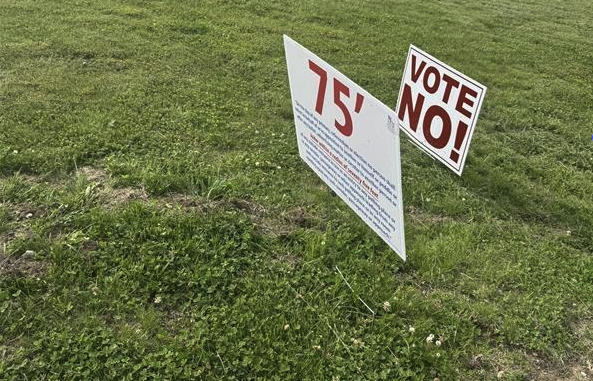
Hintz posted a response (shown below) to an email sent by Wanat to Town Manager David Cox and the full Council at 6:33 a.m. on June 2 stating: “I noticed today that the Townhall is loaded with vote no signs. This directly violates voting regulations and the 75 foot rule. Those signs should be removed immediately.”

Hintz responded publicly, pushing back on three points: (1) that the 75-foot rule is a state election statute that does not apply to town meetings and referendums; (2) that he placed the signs and verified their placement with the moderator; and (3) that Wanat’s claim that the signs violated “voting regulations AND the 75 foot rule” was a false statement.
Here is what Connecticut law says:
CGS Section 9-236 establishes a 75-foot restricted zone around polling place entrances. The statute’s own distance marker language reads: “On the day of any primary, referendum or election no person shall solicit in behalf of or in opposition to another or himself or peddle or offer any ballot, advertising matter or circular to another person or loiter within a radius of seventy-five feet of any outside entrance in use as an entry to any polling place.”
The same statute grants the moderator authority to “evict any person who in any way interferes with the orderly process of voting.”
Hintz’s claim that the 75-foot rule “has nothing to do with town meetings” is partially correct but imprecise in this context. The June 2 budget vote was a machine-ballot referendum, not a town meeting. Under Connecticut law, those are legally distinct. CGS Section 9-236 explicitly covers referendums, so the statute does apply in category to the June 2 vote. Wanat’s emailed characterization was also incomplete: what matters under the statute is whether the signs were within 75 feet of an exterior entrance and whether they constituted “soliciting” or “offering advertising matter.” Both of those determinations belong to the moderator on site, not a council member via morning email.
Hintz stated he verified placement with the moderator before the vote. The moderator’s acceptance of the placement is the operative fact under CGS Section 9-236. Wanat’s assertion that a violation was clear-cut, without that context, was an overstatement.
The Bellringer visited Town Hall around 4 p.m. on voting day, and did not see any signs within the 75-foot markers.
The public dispute between two sitting council members aired publicly on referendum morning, reflecting the same fractured dynamic on the Town Council that has complicated East Hampton’s budget process in recent years. The Bellringer verified sign placement was in compliance with the law around 4 p.m. on voting day.
What This Means for Taxpayers
A rejected budget creates uncertainty heading into July 1. Until a new referendum passes:
- The town and school system operate on a continuing basis, drawing from current appropriations where possible.
- Any capital projects requiring new authorizations, including the parking lot paving, cannot proceed.
- The Board of Finance will need to convene, deliberate, and recommend a reduced budget to the Town Council, which then sets a new referendum date.
The scope of school impacts will depend entirely on how deep the Board of Finance requires the Board of Education to cut. East Hampton has navigated this process before, but the repeated cycles carry real costs for staff stability, program planning, and community trust in the process.
We Will Continue to Cover This
This story is developing. We are tracking:
- The Board of Finance’s next meeting date and proposed reductions
- Whether tonight’s PZC vote on HOD Zone minimum acreage proceeds or is continued
- The ongoing WPCA sewer moratorium and any related Town Council action
- The POCD update timeline and whether community visioning results carry weight in any zoning decisions
The full budget document, referendum notices, and board minutes are public records available at easthamptonct.gov or by request from the Town Clerk’s Office at 860-267-2519.
Sources: Town of East Hampton Unofficial Referendum Results, June 2, 2026; Town Council Agenda Information Memo, May 12, 2026; CGS Section 9-236 (2024); East Hampton Board of Finance Meeting Minutes, June 5, 2025; WTNH: Budget cuts could cost teachers their jobs in East Hampton, April 2025; Screenshots of Karen Wanat email to Town Council and Ted Hintz social media response.
Correction:
An earlier version of this article incorrectly stated the budget numbers as previously presented in the FY2027 budget packet. Several reductions to both the education and general government budgets were made prior to the June 2 vote. The Town Council-approved budget sent to voters on June 2 was $60,452,441 a reduction of approximately $559,000 from the Board of Finance proposal published in April. Roughly 85% of those cuts came from the education budget.
Thabk you for your continued reporting on East Hampton Town events. One point of clarification- the budget that was sent to referendum on June 2 was only $60,452,441 after BOE reductions, Town operations reductions and the extra state education funding.
https://www.easthamptonct.gov/DocumentCenter/View/6169/FY-2027-TC-Approved-Budget-for-June-2-2026-Referendumpdf
Thank you for your reporting. I find it difficult to understand the situation when I have to gather snippets of information from Facebook.
While it seems that paving the parking lot may have been a positive move for the town, I believe it failed because some voters, like me, have lost trust in the town council. Between the tax waiver, the biosludge, questionable deals and cozy relationships, an aura of secrecy and collusion has been created.
I hope that the town council can win back our trust but it won’t happen with a “business as usual “ attitude. New faces on the town council would be a good start.