
Officials Urge Caution with Fireworks Due to Dry Weather and Fledging Bald Eagles
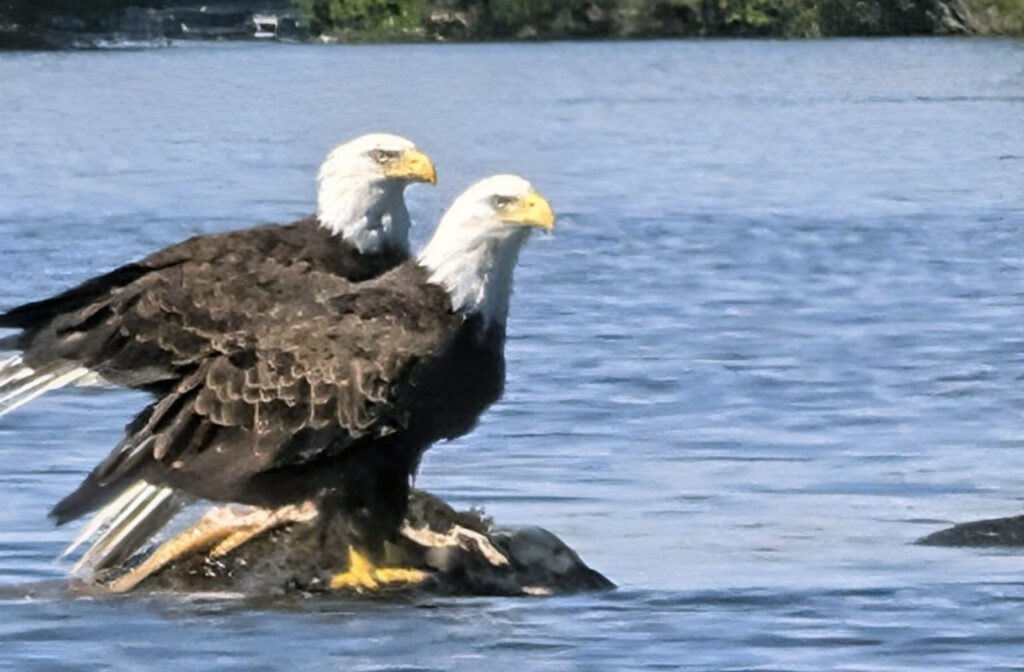
East Hampton residents have been debating a recent request from a wildlife biologist to not release any fireworks over the Fourth of July weekend to protect a pair of nesting bald eagles. In various Facebook groups, most residents agree the town shouldn’t disturb the eagles with fireworks, though some pointed out that sky explosions may be inevitable.
“People put patriotism ahead of feelings,” said Facebook user Martin Schorr on the Let’s Talk East Hampton page. “As they should.”
Only supervised displays of fireworks are legal in Connecticut, and they require a permit from the State Fire Marshal. Brian Hess, a wildlife biologist with the Connecticut Department of Energy and Environmental Protection (DEEP), sent a letter to the East Hampton Lake Commission in mid-June, recommending residents delay fireworks until July 15. Hess warned that fireworks launched earlier could “cause young to leave the nest before they are able to fly, sometimes leading to injury or death.”
Disturbance of an active bald eagle nest is a violation of federal law, which can lead to a $1,000 fine and 30 days in jail, as per the U.S. Fish and Wildlife Service. In an interview, Hess said his job is to minimize human-caused interference with nesting eagles.
“I’ve heard people argue to me you can’t prohibit thunderstorms from happening that might scare an eagle out of a nest, as well,” Hess said. “That’s true, but there are natural risks to wildlife, and there are human-caused risks to wildlife. I’m trying my best to limit those human causes risks. I’m not saying fireworks would be a violation [of federal law], there’s a risk that setting off fireworks close to the nest may have an adverse affect on those birds.”
The nest is located on the eastern shore of the lake, and federal regulations suggest no disturbances within a half-mile of an active nest. Hess wouldn’t specify the exact next location out of respect for the property owners’ privacy and the need to prevent overly curious onlookers from also disturbing the eaglets.
“Once they’re able to fly, the whole thing becomes moot,” Hess said. “We checked last week, and the chicks are still there.”
Traditionally, most nests have fledged by early July, but the cold winter may have delayed the process. Hess said if the birds haven’t fledged by July 15, then something is wrong with the nest.
If residents witness a fireworks display near the eastern shore of Lake Pocotopaug and also witness an eaglet fall out of a nest and become injured – that could be a violation of federal law, and those responsible could be subject to fines or jail time, Hess said. To report a disturbance, contact the DEEP Wildlife Division at 860-424-3208 or the U.S. Fish and Wildlife Service Northeast Region Office at 413-253-8200.
This year’s Independence Day is complicated by the 250th anniversary, which has inspired numerous celebrations of all shapes and sizes in town and across the country. East Hampton’s America 250 Committee has approved six events in July, including live music, the parade in Middletown, and a reading of the Declaration of Independence. The committee did not have any information about fireworks on its town webpage.
Celebrations are further complicated by the current drought, which three-quarters of the state is experiencing. Fireworks start an estimated 30,000 to 34,000 fires annually in the U.S., including roughly 3,500 structure fires and thousands of outdoor fires, according to the National Fire Protection Association. These incidents result in millions of dollars in property damage and dozens of injuries each year.
History
Before modern efforts to repopulate the species, Connecticut’s last nesting pair disappeared sometime in the 1950s. They didn’t return to the state until 1992, according to DEEP. There are currently 91 bald eagle territories in Connecticut.
The bald eagle became the country’s official emblem when the Continental Congress adopted it in 1782. For Indigenous peoples of the Northeast, including the Wampanoag, Pequot, Abenaki, and Quinnipiac, the eagle had already held deep spiritual significance for generations before European settlement. Despite this reverence, the two centuries that followed adoption as a national symbol were brutal ones for the species.
The bald eagle population began declining as rapid deforestation and shoreline development destroyed nesting habitats. Over time, pollution of the rivers and lakes they depended on for fish also impacted the species. Additionally, farmers would often kill eagles because they were seen as threats to livestock and game. Poachers would also harvest their feathers for the fashion industry. By the 1930s, eagles had all but vanished from the Connecticut River Valley.
Congress responded with the Bald Eagle Protection Act of 1940 (later renamed the Bald and Golden Eagle Protection Act), which made it illegal to kill, capture, or possess bald eagles. It helped, but a new and far more insidious threat was already spreading.
Beginning in the 1940s, the pesticide DDT contaminated waterways, moving up the food chain into fish-eating birds like eagles and ospreys. It didn’t kill the birds, but it caused their eggshells to thin so severely that eggs cracked under the weight of incubating parents, wiping out entire breeding seasons. The collapse was staggering: by 1963, only around 400 to 500 nesting pairs of bald eagles remained in the entire lower 48 states, down from an estimated hundreds of thousands at the time of European contact.
Recovery was slow and required active human intervention, not just legal protection Connecticut’s eagle comeback began with birds from an earlier Massachusetts effort. Progress was slow at first: as late as 1999, Connecticut had only two active nesting territories, and neither produced chicks that year.
By the 1990s and 2000s, the national recovery was far enough along that regulators began easing protections. The turnaround has accelerated dramatically in the past two decades:
- Connecticut had 19 nesting territories in 2009, 23 by 2010, and 64 in 2019. By 2020 that number had reached 72, and by 2022 the state documented at least 82 active territories across 67 towns, with biologists estimating the habitat could eventually support up to 100 nesting pairs statewide. As previously stated, there are currently 91 nesting pairs in Connecticut.
- Massachusetts, which had zero nesting pairs as recently as the early 1980s, counted at least 88 breeding territories in 2024.
- New Hampshire reached 115 territorial pairs in 2024, and 128 by 2025.
- Vermont’s population, concentrated along the Connecticut River, grew to 38 nesting pairs by 2025.
- Nationally, the lower 48 states are now home to more than 300,000 individual bald eagles and over 71,000 breeding pairs, a roughly 170-fold increase in nesting pairs since the 1963 low point.
DEEP credits much of this success to volunteers and ordinary residents who report nests and nesting behavior, such as carrying sticks and defending territory.
Why Disturbance Still Matters
Legal protection and population growth haven’t eliminated the risks eagles face during nesting season. Wildlife biologists consistently point to a few key facts:
- Nest-site selection is a fragile window. In the earliest phase of the season, when pairs are scouting and building, human disturbance can easily cause a pair to abandon a nesting attempt altogether, before a single egg is even laid.
- Incubation is a 24-hour commitment. Once eggs are laid, an adult eagle must remain on the nest almost constantly for about five weeks. Repeated disturbance that flushes an incubating bird from the nest exposes eggs to cold, predators, or overheating.
- Habitat loss remains the primary modern threat. With the chemical and legal threats of the mid-20th century largely resolved, state wildlife agencies now identify shoreline development and loss of nesting habitat as the leading pressure on eagle populations in New England.
- New hazards have emerged. Lead ammunition and fishing tackle, rodenticides, vehicle strikes, and mercury or PCB contamination in fish are all cited by state agencies as ongoing concerns even as overall numbers climb.
Both federal law (the Bald and Golden Eagle Protection Act and the Migratory Bird Treaty Act) and Connecticut law continue to prohibit disturbing active eagle nests, and wildlife officials generally recommend staying at least a quarter-mile from a known nest, observing only from a distance with binoculars, and never approaching nesting trees on foot. Loud disturbances, such as fireworks, should not happen within a half-mile.
The bald eagle’s return to Connecticut and New England is one of the most complete wildlife recovery stories in American conservation history, built on a federal pesticide ban, endangered species protections, a hands-on reintroduction program, and decades of quiet work by volunteers and biologists.
But that recovery remains ongoing and reversible at the level of an individual nest. A pair that abandons a nesting attempt because of a disturbance such as fireworks doesn’t just lose one season. Given how slowly eagles mature and reproduce, it can take years to reestablish a territory. Giving nesting eagles space isn’t just etiquette; it’s the same principle that made the recovery possible in the first place: getting out of the way and letting the birds do the rest.
Sources
- Connecticut DEEP, “Bald Eagles in Connecticut”: https://portal.ct.gov/DEEP/Wildlife/Learn-About-Wildlife/Bald-Eagles-in-Connecticut
- Connecticut DEEP, “Bald Eagle” fact sheet: https://portal.ct.gov/deep/wildlife/fact-sheets/bald-eagle
- Connecticut Council on Environmental Quality, 2023 Annual Report — “Raptors”: https://portal.ct.gov/ceq/ar-23-gold/2023-ceq-annual-report-ebook/wildlife—lobster-and-fishes/raptors
- Connecticut Council on Environmental Quality, 2018 Annual Report — “Bald Eagles”: https://portal.ct.gov/CEQ/AR-18-Gold/2018-CEQ-Annual-Report-eBook/Rivers-and-Reservoirs—Rivers-Streams-and-Rain/Bald-Eagles
- Connecticut Public, “As National Populations Surge, Connecticut’s Bald Eagle Numbers Also Soar” (2021): https://www.ctpublic.org/environment/2021-03-26/as-national-populations-surge-connecticuts-bald-eagle-numbers-also-soar
- Mass.gov / MassWildlife, “Bald Eagle”: https://www.mass.gov/info-details/bald-eagle
- Mass.gov / MassWildlife, “Learn about bald eagles”: https://www.mass.gov/info-details/learn-about-bald-eagles
- Mass.gov / MassWildlife, “Watch for bald eagles this winter” (2026): https://www.mass.gov/news/watch-for-bald-eagles-this-winter
- Mass Audubon, “Bald Eagles”: https://www.massaudubon.org/nature-wildlife/birds/bald-eagles
- Dartmouth Natural Resources Trust, “Bald Eagles on the Rise”: https://dnrt.org/bald-eagles-on-the-rise/
- Biology Insights, “Are There Bald Eagles in Massachusetts?” (2025): https://biologyinsights.com/are-there-bald-eagles-in-massachusetts/