
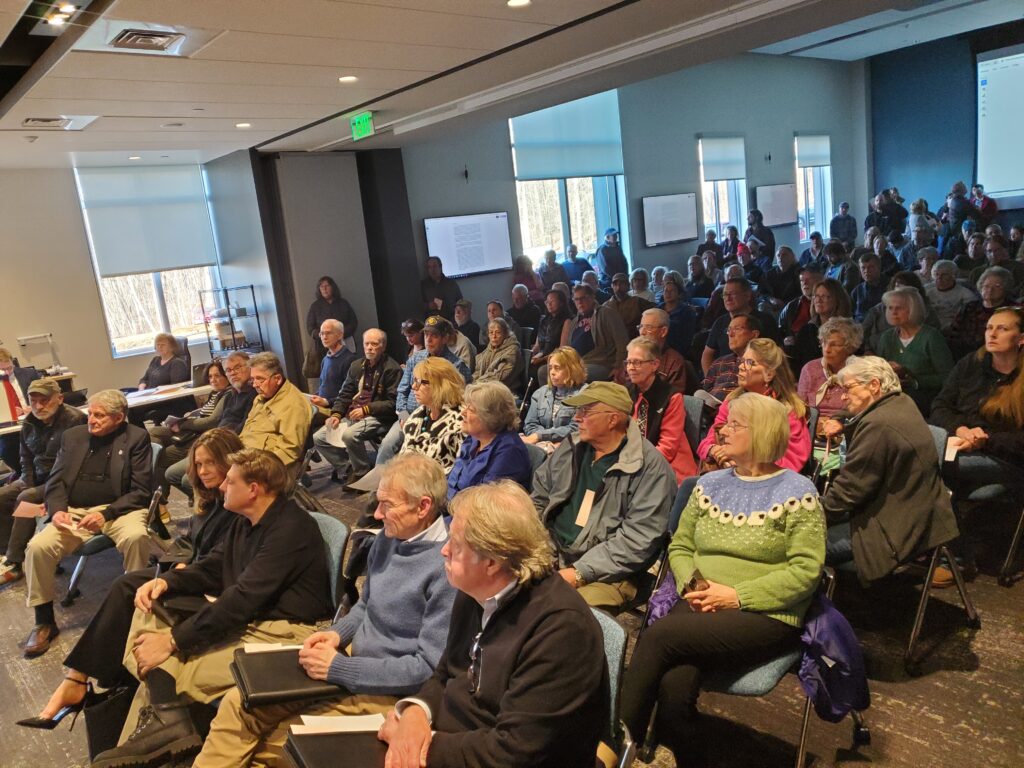
Questions remain on how long the Town Council will manage WPCA, and whether dismissals were in accordance with town code
In his first public appearance since the Town Council terminated his employment, Anthony DeSimone warned that “political control and critical infrastructure do not mix,” referencing the council’s takeover of the Water Pollution Control Authority (WPCA).
“Towns that fail to manage infrastructure competently do not remain static, they decline,” DeSimone said during the April 7 public hearing. “Every poor decision compounds over time when leadership lacks relevant experience or avoids difficult but necessary choices. The result is predictable: regulatory problems, escalating costs, and infrastructure failures that rate payers are forced to absorb.”
The hearing was being held to determine if the council should take over WPCA’s regulatory authority for an interim period, during which time the council would explore new mechanisms of oversight before restoring power to a newly constituted water authority. The measure passed unanimously, with one council member absent.
However, many residents expressed concerns during the hearing about allowing political figures to run an agency that was intended to operate independently. Mark Barmasse, former chairman of the WPCA, was one of six WPCA members whose term was abruptly ended by a Town Council vote in March, following weeks of public outcry over a land deal that many residents have alleged was conducted behind closed doors. Barmasse pointed out that the council turns over every two years, making it a challenge to consistently manage an agency that requires specific technical know-how.
“I don’t believe that the council has the time or knowledge to do this effectively nor do I believe that it’s [the] best use of the council’s time,” Barmasse said.
During the council’s discussion prior to its vote, Councilwoman Joelyn Leon also expressed trepidation about taking over the WPCA.
“I have a concern with taking on a role that I don’t feel qualified for,” Leon said, adding that she wanted “to have a better understanding of what the expectation is for this body in terms of the WPCA.”
David Cox, town manager, clarified that the wastewater treatment facility retains its managing superintendent, Paul Ceretta, and the council has the option to hire an interim public utilities administrator to replace DeSimone. Cox also said the council’s takeover would be temporary, and power would revert to a new WPCA sometime in the future.
It’s unclear how long the council expects this process to take place – the hiring of a new fulltime administrator, the reworking of oversight of the WPCA, and the reconstitution/reappointment of new WPCA members. The Bellringer has reached out to the Town Council and to Cox to seek clarification.
Questions also remain about the legal process through which the WPCA was disbanded. Chapter 146 of the East Hampton code states, in part: “a Commissioner shall be removed only after opportunity to be heard in person or by counsel before the Town Council, at least 10 days prior to which he shall have been given a copy of the charges against him.”
If a commissioner is removed, the town code also requires a record of the proceeding along with the charges and findings to be filed in the town clerk’s office.
During the public hearing, at least three speakers questioned the legality of the dismissal.
“I don’t believe you had the authority to do” that, said lawyer Timothy Furey, a Bristol resident who represents Belltown 30, a developer managed by one of the town’s largest landowners, Wayne Rand.
Council Chairman Dean Markham assured him that the council was on solid ground.
“We’re operating with legal guidance,” Markham said at the meeting.
The Bellringer has reached out to the council to get clarification on the dismissal proceedings.
We prioritize accuracy in our reporting. However, if you read something you believe to be incorrect, please let us know. Email david@thebellringer.org